







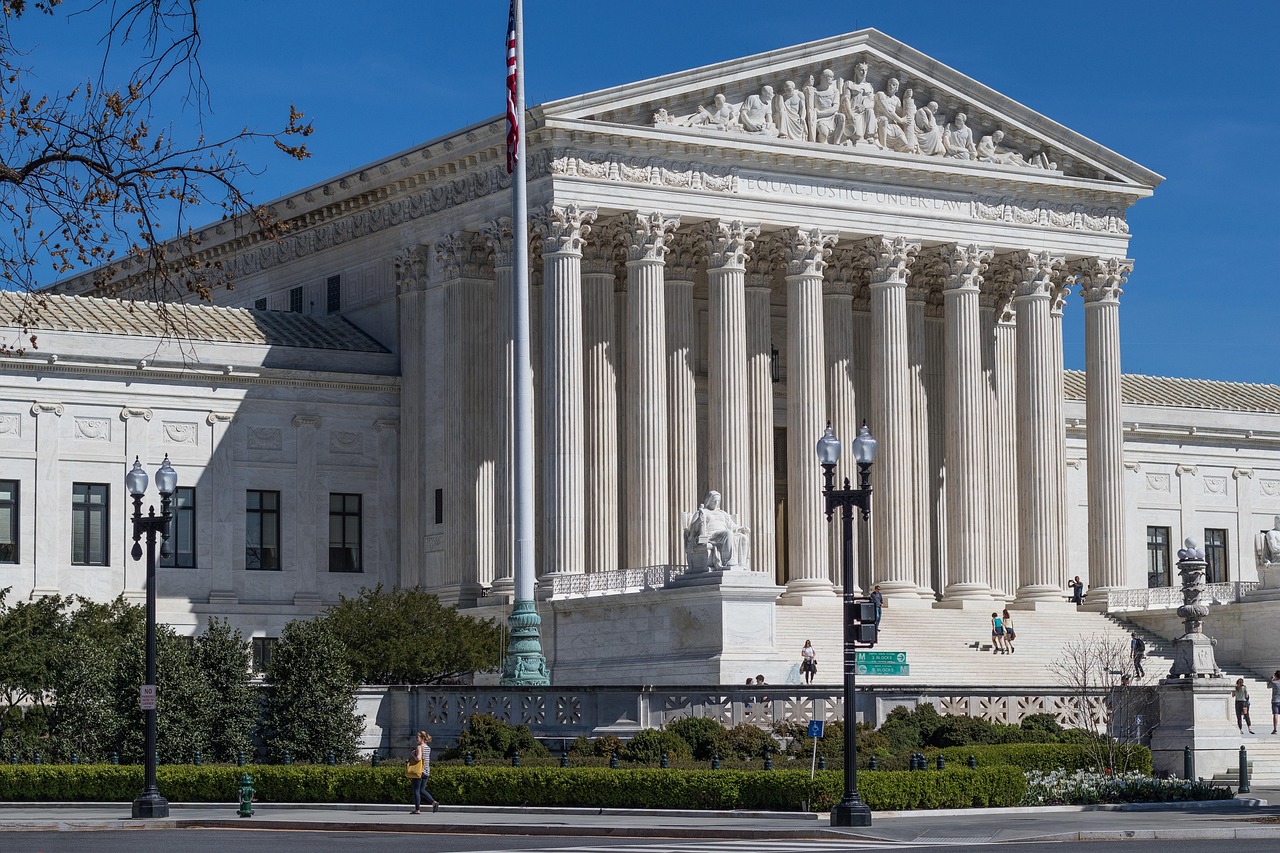
Washington, DC — A compelling and ideologically diverse coalition of free speech organizations and First Amendment scholars have filed amicus (friend of the court) briefs urging the Supreme Court to hear the Institute for Free Speech case Lowery v. Mills, which challenges a ruling that leaves public employees without legal recourse when government employers silence them through threats rather than formal discipline.
The Alliance Defending Freedom, Institute for Justice, Manhattan Institute, Protect the First Foundation, Cato Institute, Foundation for Individual Rights and Expression, National Coalition Against Censorship, and a group of more than two dozen leading First Amendment scholars all filed or joined briefs in support of granting the Institute’s petition for the Court to take the case.
The case involves University of Texas (UT) Professor Richard Lowery, who was pressured by university officials to stop publicly criticizing UT’s administration, DEI programs, and funding decisions—or face reduced pay, loss of a lucrative research post, and other consequences. Rather than risk those outcomes, Professor Lowery self-censored. Both the trial court and the U.S. Court of Appeals for the Fifth Circuit acknowledged that UT’s threats would deter “a person of ordinary firmness” from speaking, yet dismissed his First Amendment claim because the university never carried out its threats.
That ruling leaves the Fifth Circuit, which covers Texas, Mississippi, and Louisiana, at odds with ten other federal appeals courts. While the overwhelming majority of courts ask whether an employer’s conduct would deter a reasonable employee from speaking on matters of public concern, the Fifth Circuit, along with the Southeast’s Eleventh Circuit, require a completed adverse action—a firing, demotion, or formal reprimand—before an employee can sue. These outlier decisions mean that nearly 80 million people—about 23% of the U.S. population—live in states where public employees currently lack meaningful First Amendment protection against employer threats.
The new filings make clear that this gap in constitutional protection deeply troubles advocates across the ideological spectrum.
A brief by 27 scholars, comprising a who’s who of First Amendment luminaries—including Eugene Volokh (Hoover Institution, Stanford), Ashutosh Bhagwat (University of California, Davis), Erwin Chemerinsky (University of California, Berkeley), Heidi Kitrosser (Northwestern), Lyrissa Barnett Lidsky (University of Florida), Rodney Smolla (Vermont Law), Geoffrey Stone (University of Chicago), Nadine Strossen (New York Law School and past President of the ACLU), Rebecca Tushnet (Harvard), and Timothy Zick (William & Mary)—argued that the Fifth Circuit’s standard “rewards censorship by insulating government employers who successfully silence their employees through threats, such that the discipline never need be carried out.” The scholars further warned that the rule “provides a roadmap for would-be censors to silence public employees without legal consequence.” Joseph M. Terry, who is Co-Chair of Williams & Connolly’s esteemed First Amendment practice group, is counsel of record on the scholars’ brief.
Alliance Defending Freedom, which regularly represents public employees facing speech restrictions, warned in its brief that the Fifth Circuit’s rule “draws a blueprint showing employers how to avoid the First Amendment’s guarantee of freedom of speech”—inviting the most coercive threats with no fear of accountability. ADF further argued that the majority test used by ten circuits “is administrable, protects more employee speech, excludes trivial workplace annoyances, leaves employers with sufficient room to manage the workplace without undue interference, and has governed most of the country for decades without issue.”
The Institute for Justice urged the Court in its brief not only to correct the Fifth Circuit’s rule in the employment context, but to broadly reaffirm that “[g]overnment officials may not wield their authority to retaliate against protected speech. Period.” The brief argues that the circuits’ “not-adverse-enough rules have no grounding in this Court’s precedent or in basic principles of constitutional law” and have effectively given government officials “a free pass to intentionally wield their power to punish protected speech—just so long as they don’t do it too much.”
The Manhattan Institute, whose brief focuses on the particular dangers posed by the Fifth Circuit’s rule in the university context, warned that public universities have an especially wide arsenal of retaliatory tools that fall short of formal discipline—from heavier teaching loads to exclusion from research funding, administrative committees, and department colloquia. The brief argues that “administrative convenience cannot justify trampling constitutional rights” and warns that, without the Court’s intervention, “public employers will retain a panoply of tactics in their censorship toolbox to subdue and silence disfavored viewpoints.”
Finally, a brief filed by the Protect the First Foundation, the Foundation for Individual Rights and Expression (FIRE), the National Coalition Against Censorship (NCAC), and the Cato Institute argues that the Fifth Circuit’s standard causes ongoing irreparable harm, reiterating that “the First Amendment cannot permit” the government to chill its employees’ speech on matters of public concern “if free speech, thought, and discourse are to remain a foundation of our freedom.” Addressing the gap in free speech protection caused by the split, the brief notes that “[a] credible threat of discipline can be just as effective at stifling public employees’ protected speech as actually carrying out the threat.”
The breadth of this coalition is impressive—and telling. An ideologically eclectic group of respected organizations and scholars has united around a single proposition: government threats to suppress speech on matters of public concern are an affront to the First Amendment. As such, the Supreme Court must clarify that the First Amendment’s protection extends to Americans who work for the government.
Case resources:
- Institute for Free Speech cert petition in Lowery v. Mills
- Brief of Amicus Curiae Supporting Petitioner – First Amendment Scholars
- Brief of Amicus Curiae Supporting Petitioner – Protect the First Foundation, the Foundation for Individual Rights and Expression, the National Coalition Against Censorship, and the Cato Institute
- Brief of Amicus Curiae Supporting Petitioner – The Manhattan Institute
- Brief of Amicus Curiae Supporting Petitioner – Alliance Defending Freedom
- Brief of Amicus Curiae Supporting Petitioner – Institute for Justice
- Lowery v. Mills case page (with all case filings and other documents)
About the Institute for Free Speech
The Institute for Free Speech promotes and defends the political speech rights to freely speak, assemble, publish, and petition the government guaranteed by the First Amendment.