Disclaimers are the fine print on political ads that provide viewers and listeners with information about the purchaser of the ad. The most common disclaimer text is a simple “paid for by…”, but disclaimer rules vary radically from ad to ad and state to state. Some disclaimers require lengthy set scripts or information about donors to groups that created the…
This piece originally appeared in the Washington Examiner on July 13, 2020. We should have learned our lesson by now. In elections, it’s not ...
Policymakers should consider the following key principles for crafting requirements that promote accurate and effective disclaimers while minimizing costs to speech, privacy, and associational ...
Disclaimers must be simple and straightforward so that viewers can remember them and speakers are not forced to read lengthy government scripts. Yet San ...
H.B. 7329 would impose unclear reporting burdens on Connecticut residents speaking about issues of public importance in the state. The bill would also worsen ...
On behalf of the Institute for Free Speech, we respectfully submit the following in response to the Federal Election Commission’s request for comments on ...
The Institute for Free Speech (“IFS”) has reviewed the laws in all 50 states, the District of Columbia, New York City, and Seattle regulating ...
PDF available here By Eric Wang, Senior Fellow[1] One way to better understand how H.R. 1 would affect nonprofit civic and advocacy groups is ...
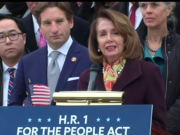
The Institute for Free Speech writes in strong opposition to H.R. 1, the “For the People Act.” More appropriately known as the “For the ...
H.R. 1, better known as the “For the Politicians Act,” would institute sweeping new limitations on speech about campaigns and public affairs. In response, ...
One way to understand how H.R. 1 would harm nonprofit civic and advocacy groups is to apply its provisions to common advocacy and operating ...